
CHAPTER IV.
LIFE OF JACOB.
Gen.
xxviii.–xxxv.
B.C. 1760–1716.
THUS solemnly assured of the Covenant Blessing, Jacob bade farewell to his mother, whom he was never to see again, and set out a solitary traveller for the Eastern uplands of Aram, where in place of a few days he was destined to spend many weary years, and amidst many trials and vicissitudes to find the same measure that he had measured to his brother measured also to himself. As the sun went down on the first evening of his journey, he reached the site of one of Abraham’s encampments, the stony soil37 near the Canaanite town of Luz. Taking of the stones that lay around, he put them for his pillow, and lay down to sleep. As he slept, there appeared to him a vision of the night. A ladder seemed to rise up from the bare ground on which he lay, and the top of it reached even unto heaven, and on it he saw angels ascending and descending. Moreover from above there came the Voice of God assuring the wanderer of His protection, renewing to him the promise of Abraham, and encouraging him with the hope of return from exile. Jacob awoke trembling and afraid, Surely, said he, the Lord is in this place, and I knew it not; how dreadful is this place! This is none other but the house of God, and this is the gate of heaven. Then rising early, he took the stone that had formed his pillow, poured oil upon it, and set it up for a memorial, calling the spot Bethel, the House of God. At the same time he made a solemn vow that, if Jehovah would indeed sustain him in all his ways, and bring him back as He had promised, he would not only dedicate the spot as His House, but would give Him the tenth of all that he possessed (Gen. xxviii. 18–22).
Then he continued his journey, and striking in a north-easterly direction, at length reached a well in Padan-Aram, round which were gathered three flocks with shepherds from Haran. As he was conversing with them, Rachel, the daughter of his uncle Laban, approached, and with true courtesy Jacob went near, rolled the stone from the well’s mouth, and watered the flocks. He then kissed the maiden, and told her he was Rebekah’s son, whereupon she ran and told her father, who welcomed Jacob to the tents of Haran. After a stay of one month, Laban proposed that the wanderer should serve him as a shepherd, to which Jacob assented, and promised to serve him seven years on condition of receiving the hand of Rachel. The seven years passed away, and he who had supplanted his brother twice, now learnt what it was to be supplanted himself. On the evening of his marriage Laban substituted her sister Leah in place of Rachel; nor was the deceit discovered till the following morning, when, in answer to Jacob’s reproaches, he informed him that it was not customary to give the younger before the elder daughter, and that if he would have Rachel he must serve seven more years for her. To these hard conditions Jacob assented, and in the course of time became the father of a numerous family, eleven sons and one daughter. Of these, Reuben, Simeon, Levi, Judah, Issachar, Zebulun, and a daughter Dinah, were born to Leah; Dan and Naphtali to Bilhah Rachel’s maid, whom the latter, finding she had no children, gave to Jacob as a secondary wife; Gad and Asher to Zilpah, Leah’s maid; and Joseph to Rachel.
Shortly after the birth of this last son, Jacob having completed his time of service, proposed to Laban that he should return into his own country. But the latter, who had found by experience that his son-in-law had brought a blessing to his house, prevailed upon him to continue in his service, on condition of receiving a certain portion of the flocks as his hire. Six years longer, therefore, Jacob staid with his father-in-law, and prospered, and became himself the owner of numerous herds. But on Laban’s side the covenant was not strictly kept. Again and again he changed the wages of his faithful servant, till at length finding any longer stay rendered impossible by the envy and jealousy of his father-in-law and his sons, and encouraged by the Word of Jehovah, Jacob determined to set out for his native land. Accordingly, availing himself of Laban’s absence at a sheep-shearing, he gathered together all his goods, and with his wives and family crossed the river, the great river Euphrates (Gen. xxxi. 21), and set his face towards the uplands of Gilead, on the east of Jordan. Three days after his departure, news of his flight reached the ears of Laban, who forthwith pursued after him a seven days’ journey, and overtook him as he was encamped in the range of Gilead. Warned by God in a dream against using any violence towards his son-in-law, Laban contented himself with reproaching him for his secret flight, hypocritically complaining that he had not given him time to send him away with due formality, and accusing him of stealing his household gods, the teraphim or images, which Rachel had taken and concealed in the camel’s furniture. After some altercation it was resolved to come to terms. Stones were gathered together, and set up as a Pillar of Witness, in token of their agreement that neither party to injure the other would cross over what was henceforth to be the boundary between their respective territories; after which Laban returned to his home in the distant East (Gen. xxxi. 43–55).
Thus relieved from pressing danger, Jacob continued his journey westward. The twenty years of exile was over, and he was bound for his native land. As if to welcome him thither, and to remind him of the fulfilment of God’s Promise, the angels, whom he had seen twenty years before in vision at Bethel, now met him in two hosts, to commemorate which event he named the spot Mahanaim (two hosts). He was now on the brink of the river which divided him from his father’s home, and the remembrance of his brother Esau and the uncertainty of the reception he might meet with from him caused the deepest anxiety. Sending messengers into the land of Seir, he informed his lord Esau of his return from the land of exile, and of the success that had attended him. The messengers went, and returned with the alarming intelligence that Esau was coming to meet him with four hundred men. Jacob’s distress was extreme, and he poured forth his whole soul in fervent prayer to God for protection. Then selecting a valuable present from his flocks and herds, he sent them to meet and propitiate his approaching brother, and at midnight dispatched his wives and sons, and all that he had, across the ford Jabbok, but staid himself behind to renew his earnest supplications for the Divine protection. Through the night, even to the breaking of the day, there wrestled with him One (Hos. xii. 3, 4), whom he knew not, and whose Name he could not prevail upon Him to reveal, but who left upon him a palpable mark of their mysterious conflict, for He touched the hollow of his thigh so that it was out of joint. But in memory of this same crisis in his life another sign was given him. His name was changed. No more was he to be called Jacob, the Supplanter. During the long years of his weary exile old things had passed away, and all things were becoming new. Henceforth he was to be known as Israel, the Prince of God, for as a Prince had he power with God and with man, and had prevailed (Gen. xxxii. 28). The site of this memorable conflict Jacob named Peniel (the face of God). When the day broke he looked up, and saw Esau approaching with his retinue. Thereupon in long procession he went forth to meet him; first advanced the handmaids Bilhah and Zilpah with their children, then followed Leah and her children, last of all Rachel and Joseph. Jacob himself led the way, bowing to the ground seven times until he came near to his brother, who ran to meet him, and fell upon his neck and kissed him. The reconciliation was complete. After mutual converse, Esau agreed to leave to Jacob the land of his inheritance, and retired himself to the rugged mountains of Seir38, whence he and his descendants expelled the aboriginal tribes, and dwelt in their stead in the land henceforth known as Edom or Idumæa, a race of hunters living by the sword.
Meanwhile Jacob continued his journey towards the valley of the Jordan, and for a while settled at Succoth, where he puts up booths (Succoth) for his cattle, as well as a house for himself. Thence he moved westwards, and crossing the Jordan, advanced into the very heart of Palestine, and pitched his tent before the city of Shechem. Of Hamor its chief he subsequently bought a portion of the rich plain, east of the city, and here he settled down, and, like Abraham before him, erected an altar to Jehovah. During his stay at this place, which appears to have been somewhat protracted, an unfortunate occurrence caused him for a time the greatest anxiety, and eventually drove him from the neighbourhood. One day, on the occasion, it is not improbable, of some local festival, Dinah the daughter of Leah, at this time from thirteen to fifteen years of age, went out to see the daughters of the land, and was dishonoured by Shechem, the Hivite chieftain, in whose territory the patriarch had settled. His father Hamor thereupon proposed that his son should pay a certain sum, by way of reparation, to her father and mother for the injury he had done to the maiden and marry her, and that this should be followed by a general intermarriage between the two peoples. To this proposition the brothers of Dinah assented, but demanded, as the single condition of the treaty, that the people of Shechem should consent to be circumcised. These terms were unwittingly accepted by the Shechemites, and three days afterwards, Simeon and Levi, Dinah’s own brothers, at the head of their households, attacked the city, slew the chiefs and all the males in the place, spoiled it of every article of value it contained, and took captive even the women and little children. This bloody and treacherous act excited Jacob’s deepest indignation, and shortly afterwards, fearful lest the neighbouring tribes should gather together and slay him and all his house, in accordance with a Divine warning, he determined to repair to Bethel and dwell there and perform the vow, which till now he seems almost to have forgotten. The journey partook somewhat of a religious pilgrimage, and was preceded by a general purification on the part of the patriarch’s followers, and a collection of the teraphim or strange gods, which had been brought from Mesopotamia, and were now hidden under an oak at Shechem. Arrived once more at the scene of his wondrous Vision, Jacob erected an altar, which he called El-Bethel, and here he was again visited by the Almighty, who renewed to him his name of Israel, and assured him of his share in the blessings of the Covenant (Gen. xxxv. 9–15). During his stay at Bethel his intimacy with his father Isaac, who was still alive, appears to have been renewed; for we are told that Deborah Rebekah’s nurse died, and was buried under an oak, henceforth known as Allon-Bachuth, the Oak of Tears. But his departure from the same place a day’s journey southwards was saddened by a grievous trial. As he drew near to Ephrath, the Canaanitish name of Bethlehem, Rachel his favourite wife died in giving birth to a son, whom she called Ben-oni, the son of sorrow, but whom his father named Benjamin, the son of my right hand. Over her grave the sorrowing husband erected a pillar, and moving southward pitched his tent beside Edar, or the watch-tower of the flocks, and subsequently beneath the oak of Mamre before Hebron, where Isaac died, in the 180th year of his age, and was committed to the tomb by Jacob and Esau (Gen. xxxvi. 27–29).
CHAPTER V.
HISTORY OF JOSEPH.
Gen.
xxxvii.–xlii.
B.C. 1727–1707.
IT was while he was sojourning in the neighbourhood of Hebron, where, like his father, he united agricultural with pastoral occupations (Gen. xxxvii. 7) that the saddest trial of his life befell Jacob. Of all his sons none was dearer to him than Joseph, the child of his beloved Rachel. In token of his affection he bestowed upon him a coat of many colours, probably a tunic furnished with sleeves and reaching down to the ankles, worn by youths of the richer class39. By some this is supposed to indicate his intention of transferring to him, as being the eldest son of the favourite Rachel, the right of primogeniture. Whether this was so or not, it roused much jealousy and ill-feeling amongst Joseph’s brothers, already incensed by the circumstance of his bearing to his father, when seventeen years of age, an evil report of the sons of Zilpah and Bilhah, with whom he kept the flocks. Another incident fanned the flame of ill-feeling. Joseph unwittingly told his brethren of two dreams he had dreamt, in one of which he had seemed to see them binding sheaves in the field, and lo! his sheaf rose and stood upright, while their sheaves stood round about and made obeisance to his sheaf; in the other he beheld the sun, moon, and the eleven stars making obeisance to him. Even Jacob rebuked his favourite son for his seeming self-exaltation, though he observed the saying (Gen. xxxvii. 11).
After a time an opportunity was presented to the brothers of taking a cruel revenge. Though Jacob was settled in the vale of Hebron, a portion of his numerous flocks and herds were kept by his sons on the rich pasture-grounds near Shechem. Thither on one occasion Jacob sent his favourite son to see how his brethren fared, and bring him word again. Joseph set out, and being directed by a man whom he met, to Dothan40, or “the Two Wells,” a place about twelve miles north of Shechem, famous for its pasturage, he went thither in quest of them. From the rising ground, where they were keeping their flocks, the brothers descried the Dreamer approaching, and straightway resolved to slay him and cast him into a pit, and then report to his father that he had been devoured by wild beasts. From actually putting him to death they were, however, dissuaded by Reuben, and contented themselves with stripping him of his coat of many colours, and casting him into an empty cistern, intending probably to let him die by hunger. But when they had done this, and had sat down to eat, a company of Ishmaelite or Midianite merchants (for the two names are used interchangeably) approached, mounted on camels, and bearing spicery and balm, going down the high road41 which passed near from Gilead to Egypt. Thereupon Judah proposed that they should sell him to these traders, and he was taken up from the pit, and sold to the Ishmaelites, who paid for him twenty pieces of silver, the usual price of a male slave from five to twenty years of age. Reuben was not present when the cruel bargain was struck, and was greatly distressed when, on his return, he found that his brother was gone. But the others killed a kid, dipped Joseph’s coat of many colours in its blood, and brought it to Jacob, with the hypocritical enquiry whether it was his son’s coat or no, and informing him that they had found it thus smeared with blood. Even Reuben did not reveal the true state of the case, and Jacob, supposing that his favourite son had been slain by wild beasts, put sackcloth upon his loins, and refusing every proffered consolation, mourned for him many days (Gen. xxxvii. 29–35).
Meanwhile the Midianitish caravan kept on its southward course, and eventually reaching Egypt, sold Joseph to Potiphar42, an officer of Pharaoh, and Captain of the Executioners (Gen. xxxviii. 36 margin). In his house, Joseph though a foreigner and a slave, gradually won the confidence of his master, who appears to have been a wealthy man, and possessed of property in the field as well as in the house, so that before long, in the capacity of overseer, he was entrusted with the entire possessions of the Egyptian, and the Divine blessing rested upon his house for Joseph’s sake.
But this period of happiness and prosperity was destined to come to an abrupt termination. With the profligacy for which the Egyptian women were notorious, the wife of Potiphar on one occasion tempted Joseph to commit adultery with her, and when he resisted all her seductions, charged him to her husband with the very crime she had ineffectually tempted him to commit. Thereupon Potiphar, fully believing her story, without bringing his faithful steward before any public tribunal, cast him into the prison in his own house. But amidst this grievous trial Joseph was not forsaken. The Lord was with him, and gave him favour in the sight of the keeper of the prison, who, convinced of his fidelity and uprightness, entrusted him with the care of all the prisoners there confined. Amongst these there soon appeared the Chief of Pharaoh’s Cupbearers, and the Chief of his Bakers, two high officers of the Egyptian court, on whom Joseph was specially directed to wait. During their imprisonment each of them dreamt a dream. The Chief of the Cupbearers dreamt that a vine was before him, on which were three branches; that it was as though it budded, and its blossoms shot forth, and its clusters brought forth ripe grapes, that of these he took and pressed them into Pharaoh’s cup which was in his hand, and gave it to that monarch. The Chief of the Bakers dreamt that he had three white baskets on his head, the uppermost full of all manner of bakemeats for Pharaoh, which the birds ate out of the baskets on his head. Convinced that these dreams portended events of great importance in their lives, and unable to interpret them, these high officers were filled with sadness. But Joseph, being informed of the cause, by virtue of his prophetic gifts interpreted the dreams, and announced to the Chief of the Butlers that within three days, on the anniversary of Pharaoh’s birthday, he should be restored to his office, while, within the same period, his fellow-prisoner would be hanged upon a tree, where the birds would eat his flesh from off him. As he had predicted, so it came to pass. Within the specified period, the one of these grandees was executed, and the other restored to his former high position. But though the Hebrew Captive had told the Chief of the Butlers his own sad story, in the hour of prosperity the restored grandee forgat his benefactor, and his touching request that he would intercede with Pharaoh on his behalf (Gen. xl. 12–23).
Two more years, therefore, of tedious imprisonment passed over Joseph’s head, when one night Pharaoh himself was troubled with two mysterious dreams. In the first he seemed to stand by the banks of the Nile, and behold out of it there came seven well-favoured kine and fatfleshed, and fed in the marsh grass that lined the banks. And behold after them there came up seven poor, ill-favoured, leanfleshed kine, and they ate up the seven well-favoured and fat kine, and when they had done so, it could not be known that they had eaten them, for they were still as ill-favoured as at the beginning. In his second dream, the monarch beheld seven ears of corn growing upon one stalk, full, fat, and good, and after them seven thin ears and blasted with the east wind, which devoured the seven full and fat ears. Troubled with these visions of the night he awoke, and sent for all the magicians of Egypt and all the wise men thereof, and told them his dream, but they were unable to give him any interpretation. In this difficulty the Chief of the Butlers bethought him of his youthful benefactor in the prison, and told Pharaoh what had befallen him there, and how a young man, a Hebrew, servant to the Captain of the Executioners, had interpreted his dream. Upon this the monarch sent for Joseph, who was brought into the royal presence, and having been told the nature of the dreams, informed Pharaoh that they were sent by the great God to forewarn him of what He was about to do. The seven good kine and the seven good ears denoted seven years of plenty; the seven thin ill-favoured kine and the seven empty ears of corn denoted seven years of very grievous famine, about to befall the entire land of Egypt. The doubling of the dreams denoted that the event was certain and imminent. He advised, therefore, that without delay the monarch should set over the land a man discreet and wise, with overseers under him, to take up the fifth part of the land during the seven years of plenty, and lay up corn and food in various cities against the seven years of famine, which were assuredly to come (Gen. xli. 14–36).
This advice found favour in the eyes of Pharaoh, and deeming no other so well fitted for the post as the interpreter of his dreams, he appointed him to fill it, and, in token of his freedom, placed on his hand his own signet ring and a gold collar about his neck, and arraying him in vestures of fine linen, he caused him to ride in the second chariot that he had, preceded by heralds crying Bow the knee. Joseph was thus invested with the dignity of an Oriental Vizier, and could act in the name of the king. Besides these marks of honour, Pharaoh changed his name to Zaphnath-paaneah43, or the Revealer of Secrets, and united him in marriage with Asenath44, the daughter of Poti-pherah (devoted to Ra, or the Sun), priest or prince (Gen. xli. 45 margin) of On, the later Heliopolis, and the religious capital of the country.
Thus at the age of thirty, after thirteen years of painful vicissitudes, the son of Jacob was elevated to the highest position next to the sovereign himself in the great kingdom of Egypt. In accordance with the plan he himself had indicated, he straightway commenced a tour throughout the land, and during the seven years of plenty bought up a fifth part of the corn in the country, and laid it up in granaries in the various cities. During the same period he became the father of two sons, to whom, though born of an Egyptian wife, he gave Hebrew names, calling the first-born Manasseh, “a Forgetter;” for God, said he, hath made me forget all my toil and all my father’s house. The second he named Ephraim, “Fruitful;” for God hath caused me to be fruitful in the land of my affliction. At the close of the seven years of plenty, the seven years of dearth drew on, and its effects were felt not only in Egypt, but in all the neighbouring lands. During the first part of this period, the wants of the people were relieved by the abundance which the foresight of the Vizier had stored up. He opened all his granaries and sold unto the Egyptians, delivering over the money into Pharaoh’s exchequer. When money failed, barter was resorted to, and the Egyptians obtained bread in exchange for their horses, cattle, and flocks. When at length these means were exhausted, they sold him their land, except that of the priests, who, being provided from the royal treasury, did not feel the horrors of the famine. Thus possessed of the entire country, Joseph improved the opportunity to place the relations between the Egyptian monarch and his people on a settled and legal footing. He made them, indeed, vassals of their sovereign, but in place of allowing them to be taxed according to royal caprice, he disposed of the land to them, on the understanding that four parts were to be their own, for seed of the field, and for food for them and their families, while a fifth part was to be paid annually to the king in place of ground-rent; an arrangement by no means oppressive, when it is considered that the soil sometimes yielded thirty-fold, or even a greater increase (Gen. xli. 46–57).
At an early period during the seven years of famine, ten of Joseph’s brethren went down into Egypt at the suggestion of their father, and presented themselves before him with the petition to be allowed to buy corn. In the Viceroy, second only to the great Pharaoh, they did not for a moment recognize the boy whom twenty years before they had lowered into the dry pit at Dothan. But though Joseph knew them, and recognized the fulfilment of his early dreams, he did not reveal himself to them. Through an interpreter he spake roughly unto them, pronounced them to be spies who had come down to see the nakedness of the land, and when they denied the charge, declared they should be imprisoned till one of them had brought down their youngest brother. For three days he actually kept them in ward, and finally, on condition that one remained behind as a hostage, permitted them to return with corn for their families. Stricken with remorse, and not imagining that the Viceroy could understand their language, they acknowledged that their sin had found them out, and recalled the day when they saw the anguish of their brother, and turned a deaf ear to his beseeching entreaties that they would not deal hardly with him. Then Simeon was bound before their eyes, and sad and sorrowful they commenced their return. But on the road they had fresh cause for alarm and confusion. On opening their sacks they discovered not only that corn had been supplied them, but that their money had been restored to them. Marvelling at this strange circumstance, they reached home, and recounted to their father all that had befallen them, and how he could not hope to see Simeon again till they returned with their youngest brother Benjamin into the presence of the Viceroy of Egypt. On hearing this hard condition, Jacob burst forth into bitter complaints, and though Reuben offered the life of his two children as a pledge for Benjamin’s safe return, absolutely refused to allow him to accompany them; his brother, said he, is dead, and he is left alone; if mischief befall him by the way, then shall ye bring down my grey hairs with sorrow to the grave (Gen. xlii. 38).
CHAPTER VI.
JACOB’S DESCENT INTO EGYPT—DEATH OF JOSEPH.
Gen.
xliii.–l.
B.C. 1707–1635.
BUT as time went on, and the corn the Brothers had brought from Egypt was consumed, it became absolutely necessary to go thither a second time, if they would live and not die. Without Benjamin, however, they knew the journey would be useless, and Benjamin their father would not send. At length Judah stood forward as spokesman for the rest, and offered to bear for ever in his own person the blame, if any evil befell him, till after a struggle Jacob consented. With a present of such things as the land afforded, a little balm, a little honey, spices, and myrrh, nuts, and almonds, with double money also in their hand, the brothers took Benjamin from his sorrowing father, and once more commenced their journey to Egypt. Arrived there they were again presented to the Viceroy, who perceiving that Benjamin was with them, ordered the steward of his house to conduct them home, and to slay and make ready, that they might dine with him at noon. Full of fear, the brothers followed the steward, and on the way informed him of their surprise, when on their return from their previous visit, they found their money in their sacks. The steward, however, answered them kindly, restored Simeon to them, and brought them water to wash their feet. At noon Joseph returned, and the brothers spread out the present their father had sent, bowing themselves before him to the earth. After some questions touching the welfare of the old man they had left in the land of Canaan, he lifted up his eyes, and saw his brother Benjamin, his mother’s son, and his whole soul yearned towards him, and he entered into his chamber and wept there. Thence having washed his face he returned, commanded the attendants to set on bread, and the brothers sat down ranged each according to his age. Joseph sat at a table by himself, and the Egyptians in his retinue by themselves; for to eat bread with the Hebrews was regarded by them as an abomination. Then from Joseph’s table portions were sent to his brethren, but Benjamin’s portion was five times as great as any of theirs, and they drank and were merry with him (Gen. xliii. 34).
The next morning, as soon as it was light, with sacks replenished, and rejoicing at the successful termination of their journey, the sons of Jacob commenced their return to Canaan. But they had proceeded only a little way from the city, when the Steward of Joseph overtook them, and charged them with returning evil for all the good they had received, and stealing the silver divining cup45 (Gen. xliv. 5) belonging to his master. In the full assurance of their innocence, the brothers not only denied the charge, but declared their willingness that the guilty one should die, and the rest become bondmen to the Viceroy. The sacks were, therefore, taken from the asses, and lo! in Benjamin’s sack, where it had been purposely placed by Joseph’s command, the cup was found. Horror-struck at the discovery, the brothers returned to the house, and flinging themselves on the ground before Joseph, expressed their resolution to become slaves with Benjamin rather than return without him to his heart-broken father. In the dialogue that ensued Judah was again the chief speaker. God, he owned, had found out their iniquity, and they and he with whom the cup had been found would become Joseph’s bondmen. To this, however, Joseph would not consent; he with whom the cup had been found, he alone need remain behind in servitude, the rest might return in peace to their father. Then Judah went near to him, who was even as Pharaoh (Gen. xliv. 18), and in words of utmost pathos related how in obedience to his command, their father had with great difficulty been prevailed on to suffer the child of his old age to accompany them, and how, if he failed to return, he would certainly die, for his life was bound up in the life of his favourite son. Nay, more, he continued, he himself had become surety for the lad, and was now ready, rather than bring down the old man’s grey hairs with sorrow to the grave, to remain alone in the land of Egypt a bondman unto his lord, if only Benjamin and the rest might return into the land of Canaan (Gen. xliv. 18–34).
As Judah proceeded with his moving tale, Joseph could restrain himself no longer. He desired every man to leave the chamber, and he and his brethren were left alone. Then, amidst many tears, he at length broke forth with the astounding words I am Joseph, coupling the revelation with the enquiry Doth my father yet live? But the brothers were too terrified to answer him a word. Thereupon he bade them come near unto him, and again assured them that he was Joseph, their brother, whom they had sold to the Midianitish caravan. Let them not, he said, be grieved that they had sold him into Egypt. God, who orders all things, had sent him thither before them to preserve their lives, and had made him a father unto Pharaoh, and ruler throughout all the land of Egypt. Instead of repining for the past, let them return to the old man, their father, and tell him of all his glory in Egypt, and bring him down, and settle, they and their children, their flocks and their herds, and all that they had, in the goodly country of Goshen, frontier. Having thus at length poured forth his pent up feelings, Joseph fell upon Benjamin’s neck, and wept, and kissed him, and likewise all his brethren. Tidings of what had occurred soon reached the ears of Pharaoh, who readily assented to Joseph’s wish that his father should be suffered to settle in the land. Waggons were then made ready to bring him and all that he had; ample provisions were supplied for the journey, and rich presents bestowed upon all the brothers, but especially on Benjamin. Then with a parting charge to see that they fell not out by the way (Gen. xlv. 24), the sons of Jacob returned to their father, and recounted to him all the strange events that had befallen them. The long lost Joseph, the son of the beloved Rachel, was alive, nay, he was governor over all the land of Egypt. At the first announcement Jacob’s heart failed him, nor could he believe their words. But when the waggons that Joseph had provided came in sight, then at length his spirit revived, and he exclaimed, It is enough, Joseph my son is yet alive, I will go and see him before I die (Gen. xlv. 28).
To forsake, however, the familiar pasture grounds of Hebron, to leave the soil promised to him and to his seed for ever, required of the patriarch no little resolution. Abraham had gone down to Egypt, but only to involve himself in great difficulties; Isaac had been on the point of going thither, when he was restrained by the hand of God (Gen. xxvi. 2). Did the Divine Blessing rest on that journey, which an imperious necessity now induced him to essay? Jacob was not long left in doubt. On reaching Beersheba the Almighty appeared to him in vision, and bade him lay aside all apprehensions. In Egypt, in the land of the mighty Pharaohs, He would not fail to protect him, there He would make him a great nation, and thence in the fulness of time He would bring his seed back to the Land of Promise. Thus encouraged Jacob arose from Beersheba, and with his sons, their wives, and their little ones, their herds, their flocks, and all the goods they had gotten in the land of Canaan, commenced his journey. Judah led the way, and on the frontier of Egypt the patriarch met his long lost son, and fell upon his neck, and wept on his neck a good while. Arrived in the land of the Pharaohs, five of Joseph’s brethren were introduced to the reigning monarch. They told him that they were shepherds, that they had come down into Egypt in consequence of the severity of the famine, and requested permission to settle as strangers and foreigners in Goshen, the most easterly frontier-land of Egypt, and offered to become guardians of the royal herds. Permission was granted, and Jacob himself was introduced to Pharaoh, and bestowed his blessing upon the monarch (Gen. xlvii. 1–10).
The period of Jacob’s own sojourning in the land of Ham (Ps. cv. 23) was limited to seventeen years, at the close of which he had reached the age of 147, and perceived that his end was nigh. Informed that his father was sickening, Joseph brought his two sons Ephraim and Manasseh and placed them before his bedside. Guiding his hands wittingly, the aged patriarch stretched out his right hand and laid it on Ephraim’s head, though he was the younger, and his left hand on Manasseh’s head, though he was the firstborn. At this Joseph was displeased, and would have altered the disposition of his father’s hands. But Jacob refused, and with his hands as they were, bestowed upon the young men and their father his solemn and abiding blessing. Though born in Egypt, Ephraim and Manasseh were to be reckoned as his own sons, and would both grow into great tribes. But as it had been in Jacob’s own case, so would it be with them; the younger brother would be greater than the elder, and his seed should become a multitude of nations. Then turning to Joseph the Patriarch bestowed on him a special mark of affection, even one portion above his brethren, a piece of land which with his sword and his bow he had conquered from the Amorites, probably outside the green vale of Shechem (Gen. xlviii. 22, Josh. xvii. 14, &c.).
And now the day drew nigh when the Patriarch’s eventful life must close. Wishing by virtue of the gift of prophecy, which gained greater power the nearer he approached the borders of the eternal world, to tell them that which should befall them in the last days, he desired that his sons might be summoned to his bedside. Obedient to his word, they gathered round him, and then in prophetic trance “but having his eyes open,” he beheld the mighty vision of the future, and predicted their several fortunes in the land, through which he himself had wandered as a pilgrim for more than one hundred years. First, before him stood Reuben, over whom in the tents of Laban he had rejoiced as his firstborn, his might, and the beginning of his strength. To him by the law of primogeniture belonged the headship of the family, and the double inheritance. But he had proved unworthy of his vocation. Unstable as water, he should not excel. Next in order of their birth came Simeon and Levi. Brethren of one mother, they had been also brethren in cruelty and deceit. In their conduct towards the Shechemites they had proved the fierceness of their anger, and the cruelty of their disposition. Unworthy were they to be the head of a nation which was to be a blessing and not a curse to all peoples of the earth, therefore were they to be divided in Jacob, and scattered in Israel. Next came Judah, and to him the patriarch could assign a portion at least of the blessing of the firstborn. His should be the pre-eminence in power and dignity, him should his brethren praise, before him should his father’s children bow down; his should be the Sceptre and the Lawgiver, nor from beneath his feet should they ever depart, till Shiloh, the Peaceable or Peace-maker came46 (Gen. xlix. 1–10).
Having thus transferred the privileges of the firstborn to Judah and predicted the fortunes of his other sons, the dying Patriarch once more solemnly adjured them, as he had already adjured Joseph, not to leave his bones in Egypt, but to carry them into the land of Hope and Promise, and lay them in the cave of Machpelah, in the family-grave of his fathers, and then he gathered up his feet into the bed, and yielded up the ghost. Obedient to such reiterated commands, Joseph caused his father’s body to be embalmed in the Egyptian fashion by the physicians, and obtained permission from Pharaoh to accompany his remains to the burial-place he had marked out for them. Then at the head of a numerous retinue, composed not only of the members of his own family, but also of the court-officers of Pharaoh, and the grandees of the empire, and accompanied by chariots and horsemen, he set out. The nearest road would have been by Gaza, and through the territory of the Philistines. Instead of this, the funeral procession took a long circuitous route round Mount Seir47 and the eastern side of the Dead Sea, and halted at the threshing-floor of Atad, on the east side of the Jordan, opposite Jericho. Here seven days were spent in solemn mourning, and so grievous was the lamentation that the Canaanites of the Jordan valley called the spot Abel-Mizraim, the Meadow, or the Mourning of the Egyptians. Further than this point the Egyptian retinue do not seem to have proceeded. The sons of Jacob alone crossed the Jordan, into the land of Canaan, and laid their father in the cave of Machpelah, by the side of Abram, Isaac, and Sarah (Gen. l. 1–13).
The funeral over, Joseph and his brethren returned to Egypt. Fearful now their father was dead that the Viceroy would requite them for all the evil they had done towards him, the sons of Jacob sent a messenger to intercede in their behalf. But Joseph calmed their fears, and assured them of safety and protection. Together, then, they dwelt in peace and security in the land of Goshen; and Joseph saw Ephraim’s children of the third generation, and the children of Machir the son of Manasseh brought up upon his knees. At length, when he had reached the age of 110, perceiving that his end was near, he sent for his brethren, and having assured them that God would certainly visit them, and bring them up out of Egypt into the land which He had promised to their forefathers, and taken an oath of them that they would remove his bones into the same Good Land, he died, and was embalmed, and laid in a coffin in Egypt (Gen. l. 26).
Note.
SURVEY OF THE PATRIARCHAL AGE.With the death of Joseph the Patriarchal Age of Israel’s history may be said to close. The Family had now thrown out many branches, and was on the point of merging into the Nation. At this juncture, then, it may be well to look back, and review some of the chief features of Patriarchal Life.
i. And the first of these that claims attention is its Nomadic character. Unlike the founders of Egypt, of Babylon, of Nineveh, the Patriarchs were not the builders of cities and towns, but pilgrims and sojourners, dwellers in tents (Heb. xi. 9). But they were very different from rude hordes, like the Amalekites and other “sons of the desert,” abhorring any higher mode of life. Abraham was no stranger to the highest form of civilization that his age afforded. He was acquainted with Ur, with Nineveh, with Damascus, with Egypt; he had left his home in one of the chief cities of Mesopotamia, not from choice, but in consequence of a direct personal call from God. Moreover, so far from regarding his present mode of life as an ultimate end, he and Isaac and Jacob, were ever looking forward to a time when it would close, when their descendants should be settled in the Land of Promise, and become a great nation, when the portable tent should give way to the city that had foundations (Heb. xi. 10, 13–16; comp. Gen. xxiv. 7; xxviii. 4; xlix. 1–27; l. 24). Hence, from time to time, as opportunity offered, we see the wandering life freely and willingly laid aside. Lot settled in Sodom (Gen. xiii. 10–12); Abraham in Egypt went direct to Pharaoh’s court (Gen. xii. 14); at Hebron he settled and became a “prince of God” in the midst of the Hittites (Gen. xxiii. 6); Isaac not only lived near the Philistines, but occupied a house opposite the palace (Gen. xxvi. 8), and practised agriculture (Gen. xxvi. 12); and Joseph’s dream of the sheaves points out that this was also continued in the time of Jacob (Gen. xxxvii. 7)48.
ii. The Family was the centre of the Patriarchal commonwealth. Its head was the source of authority and jurisdiction; he possessed the power of life and death (Gen. xxxviii. 24); he united in himself the functions of chief and priest; he offered the burnt-offering; he had his armed retainers (Gen. xiv. 14; xlviii. 22; xxxiv. 25; xxxiii. 20); his intercourse with his wives (for polygamy was not forbidden) was free and unrestrained; the wife’s consent was asked before wedlock (Gen. xxiv. 57, 58); love hallowed the relations of Abraham with Sarah, of Isaac with Rebekah, of Jacob with Leah and Rachel; woman, indeed, did not occupy the position since conceded to her, but her position was far from degraded, and the sanctity of the marriage-bond was defended by severe laws, which made death the punishment for adultery (Gen. xxxviii. 24). Slavery, it is true, existed, but in the tents of Abraham the slave was ever treated with consideration, and not excluded from, but made a partaker of religious privileges (Gen. xvii. 13). The fidelity and attachment of Eliezer the steward of Abraham’s house, the mourning for Deborah Rebekah’s nurse (Gen. xxxv. 8), are pleasing proofs of the peace that reigned in the Patriarchal household.
iii. Civilization. The life of the Patriarchs was chiefly that of the shepherd, and their wealth mainly consisted in their flocks and their herds. But besides practising agriculture they were not unacquainted with money and the precious metals. Abraham paid for the field of Machpelah with coin (Gen. xxiii. 9–20), and the sons of Jacob took money with them into Egypt (Gen. xlii. 25, 35); while the gold ring and armlets presented to Rebekah by Eliezer (Gen. xxiv. 22), the bracelet and signet ring of Judah (Gen. xxxviii. 18), the ear-rings of Rachel (Gen. xxxv. 4), the many-coloured coat of Joseph, indicate an acquaintance with the luxuries of life.
iv. Religion. While other nations were rapidly learning to deify the powers of nature, the Patriarchs believed not only in a God above and beyond nature, but in a God Personal, Omnipotent, and Holy. The God of Abraham, Isaac, and Jacob was no mere abstraction, no mere law. He could and did reveal Himself by angelic appearances, by visions, by dreams; He could console, strengthen, encourage; He could punish, rebuke, and on repentance forgive. Abraham, the Friend of God (Jas. ii. 23), intercedes with Him in behalf of Sodom and Gomorrah (Gen. xviii. 23–33); Isaac is warned by Him against going down into Egypt (Gen. xxvi. 2); Jacob is consoled by Him at Bethel when setting out into the land of exile (Gen. xxviii. 13–15), and wrestles with Him by the fords of Jabbok till the break of day (Gen. xxxii. 24); Joseph believes in His invisible but ever-present help in prison and in a strange land, and ascribes to Him all his wisdom in the interpretation of dreams (Gen. xli. 16). The Divine Promise of a great future Abraham believed under circumstances of greatest trial, and his faith was counted to him for righteousness (Rom. iv. 3). Moreover the God of the Patriarchs was no mere “national or household God.” His sphere of operation was not restricted to the Patriarchs and their families; He is the God of all the earth (Gen. xxiv. 3), the God of Righteousness and Holiness. He punishes the people of Sodom and Gomorrah (Gen. xix. 24, 25); He plagues Pharaoh’s house (Gen. xii. 17); He is the God of the priest-king Melchizedek (Gen. xiv. 18), and of the Philistine Abimelech (Gen. xx. 3); He protects not only Isaac the “child of promise,” but the outcast Ishmael the “child of the bondwoman” (Gen. xxi. 13); He is with Joseph in prison, but He sends dreams to Pharaoh, and through Joseph He saves Egypt from famine (Gen. l. 20).
v. The Religious Worship of the Patriarchs was in keeping with the simplicity of their creed. The head of the family was also the priest of the family. Whenever Abraham, Isaac, or Jacob, reached any new spot in their pilgrimage, they invariably erected an altar, generally of stone and on a high situation (Gen. xxii. 9; xxvi. 25; xxxv. 7); there they called on the name of Jehovah, there they presented their burnt sacrifice, there they offered up their prayers. Their history also proves the existence of offering covenant-sacrifices, and celebrating covenant-feasts (Gen. xv. 9–18; xxi. 32); the making and paying of vows (Gen. xxviii. 23); the erection of memorial pillars, and the consecration of them by pouring upon them oil and wine (Gen. xxviii. 18); the rite of circumcision (Gen. xvii. 10–14); and the paying of tithes (Gen. xiv. 20)49.
vi. The Character of the Patriarchs is never represented as perfect, their faults are freely exposed, theirs is no ideal history. If we compare the four most eminent amongst them, we seem to trace in (i) Abraham, “the faith that can remove mountains” in its power and in its fulness, revealing itself in unfaltering trust and unquestioning obedience under the most trying circumstances conceivable; in (ii) Isaac, the faith that can possess itself in patience, and discharge the ordinary duties of life in quietness and waiting; in (iii) Jacob, the violent contest of faith with the flesh, the higher with the lower nature, till by hard discipline the latter is purified, and the “Supplanter” becomes the “Prince,” the “Prevailer with God;” in (iv) Joseph, the fidelity and perseverance of faith, revealed not only in the patient endurance of the most grievous trials, but in energetic action, and at length crowned with victory. “He unites in himself the noble trust and resolution of Abraham, with the quiet perseverance of Isaac, and the careful prudence of Jacob.” He is moreover an eminent historic type of Christ, in (1) his persecution and sale by his brethren, (2) his resisting temptation, (3) his humiliation and exaltation, (4) his dispensing to a famine-stricken people the bread of life, (5) in the fulness of his forgiving love50.
BOOK III.
FROM THE SETTLEMENT OF THE ISRAELITES IN EGYPT TO THE GIVING OF THE LAW.
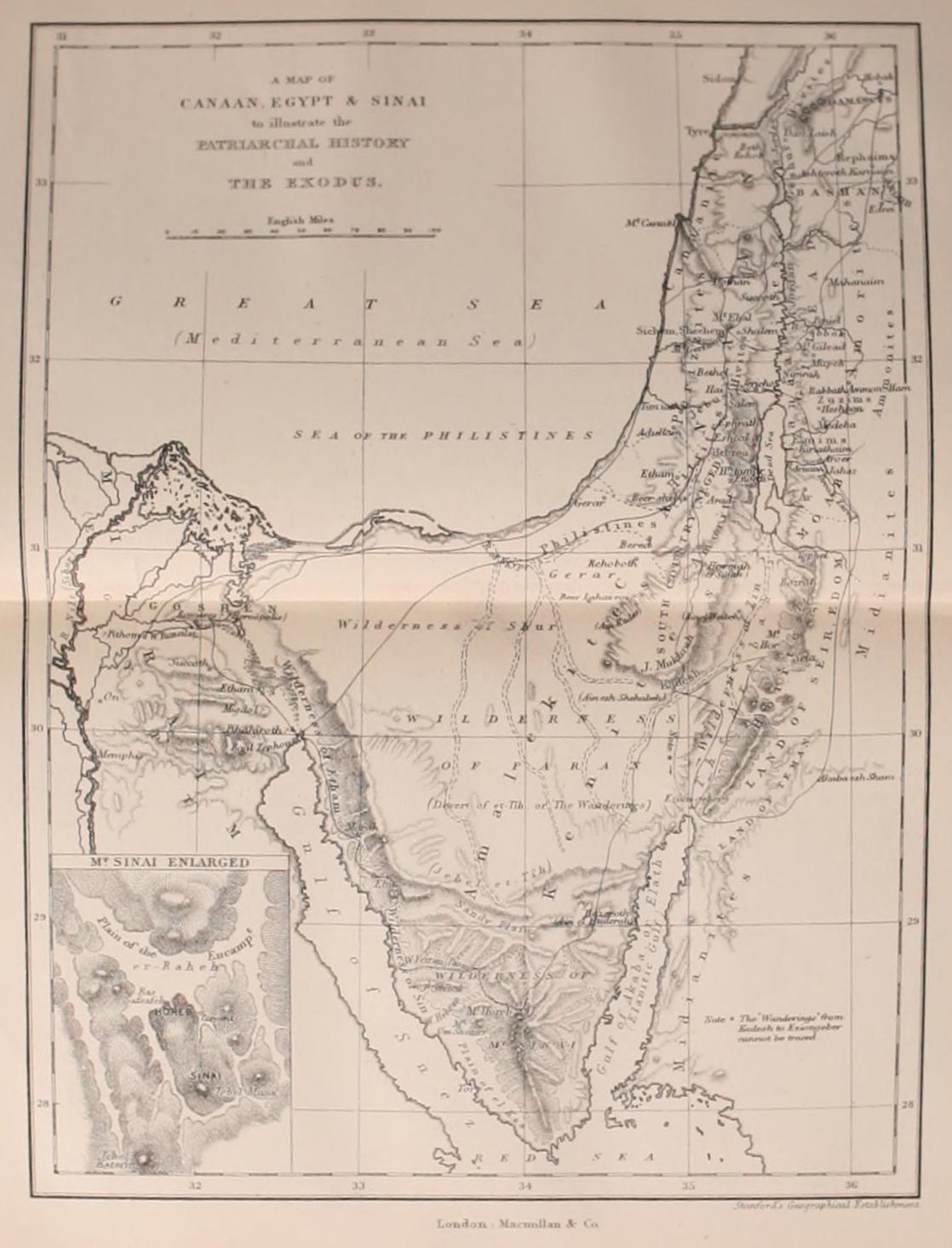
A MAP OF CANAAN, EGYPT & SINAI
to illustrate the
PATRIARCHAL HISTORY
and
THE EXODUS.
Stanford’s Geographical Establishment
London: Macmillan & Co.
CHAPTER I.
THE BIRTH AND CALLING OF MOSES.
Exod.
i.–vi.
B.C. 1706–1491.
THE district of Goshen (frontier), also called the Land of Rameses (Gen. xlvii. 11), where the Israelites were settled during the period of their sojourn in the land of the Pharaohs, was the most easterly border-land of Egypt. It was scarcely included within the boundaries of Egypt proper, and was inhabited by a mixed population of Egyptians and foreigners (Exod. xii. 38). Eminently a pasture land and adapted to the rearing of flocks and herds, it included also a considerable portion of fruit-bearing soil, which owed its fertility to the overflowing of the Nile, called by the Egyptians Hapi-Mu, the genius of the waters, by the Israelites Sihor, or Shihor, the black (Is. xxiii. 3; Jer. ii. 18). Touching on the west the green valley of this wondrous river, and stretching onwards to the yellow sands of the Arabian desert immediately south of Palestine, it was then, as it has always been, the most productive part of Egypt, yielding luxuriant crops of wheat and millet, and abounding in cucumbers and melons, gourds and beans, and other vegetable growths (Num. xi. 5).
Sacred History does not reveal to us many particulars respecting the early portion of the period during which the sons of Jacob sojourned in the land of Ham. We know that they were fruitful and multiplied and waxed exceeding mighty, so that when the time came for them to go forth from Egypt they could scarcely have numbered less than two million souls. We need not, however, suppose that these were all the direct descendants of the seventy immediate relatives of Jacob. When that Patriarch and his sons went down into Egypt they would naturally take with them not only their flocks and herds, but their menservants and maidservants (Gen. xlv. 10, 11). Of the number of these we can form some calculation by remembering the 318 trained servants, who accompanied Abraham at the rescue of Lot51 (Gen. xiv. 14); the great store of servants possessed by Isaac (Gen. xxvi. 13, 14), two-thirds at least of whom passed into the possession of Jacob, and must be added to the two hosts which he brought from Mesopotamia (Gen. xxxii. 7, 8). But even thus their increase was marvellous, and must be ascribed to the direct superintending Hand of God. The effect, however, of their stay was perceptible in other respects. They not only increased in numbers, but became acquainted with many arts and sciences, and thus fitted for their future national existence. One portion, indeed, of the nation seems to have retained its pastoral habits even to the end. The descendants of Reuben, Gad, and Manasseh (Num. xxxii. 1) probably tended their large flocks and herds on the eastern border of Goshen, but others settled in the cities and villages on the confines of the land of Goshen, and not only adopted more generally agricultural pursuits (Deut. xi. 10), but became acquainted with many useful arts, with writing, the working of precious and common metals, the grinding and engraving of precious stones, with carpentry, byssus-weaving, and pottery (1 Chr. iv. 14, 21, 23), with fishing, gardening (Num. xi. 5), and artificial irrigation (Deut. xi. 10)52. On the other hand, they could not fail to become acquainted with forms of religious worship hitherto utterly unknown to them. Now, for the first time, could they witness the gorgeous and mysterious ceremonies that attended the worship of Ra, the “Sun-God,” or of Isis and Osiris. Now, for the first time, they might behold the incense burnt three times every day53, and the solemn sacrifice offered once a month to the sacred black calf Mnevis at On (Heliopolis), or to his rival the bull Apis at Memphis. Now they saw, as they could scarcely have seen elsewhere, the adoration of the creature rather than the Creator carried to its furthest point, and divine honours paid not only to the mighty Pharaoh, the Child, the representative of the Sun-God, but to almost everything in the heaven above, and the earth beneath, and the waters under the earth, to the crocodile and the hawk, the cat and the dog, the hippopotamus and the serpent. That the simple patriarchal faith of the descendants of Abraham and Isaac and Jacob would suffer from contact with such diverse forms of idolatry might naturally be expected. The worship of the sacred calf exercised over them a peculiar fascination. Your fathers worshipped other gods in Egypt, says Joshua afterwards (Josh. xxiv. 14), they forsook not the idols of Egypt, is the accusation of Ezekiel (Ezek. xx. 7, 8; xxiii. 3).
But an important event exercised a still greater influence on their social and religious condition. A change took place in the reigning dynasty. There arose a new king over Egypt (Ex. i. 8; Acts vii. 18) that knew not Joseph, who regarded with no friendly feelings the strange community with alien rites and traditions, settled on the eastern outskirts of his realm. He viewed with alarm their rapid increase, and dreaded lest, in the event of a war, instead of guarding his kingdom against, they might join the enemies of Egypt, the roving tribes of the East, “the terror of the inhabitants of the Nile valley,” and fight against his own people, and effect their escape from the land. Accordingly he determined to reduce them to the condition of public serfs or slaves; and in order to crush their free and independent spirit, set taskmasters over them, and employed them in gigantic works, making bricks for his treasure cities, Pithom and Raamses. Day after day, therefore, their lives were made bitter with hard bondage, while beneath a burning rainless sky, naked and in gangs, they toiled under the lash in the quarry or the brick-field. But this expedient did not produce the effects the monarch desired. The more they were afflicted, the more this strange people grew and multiplied, and waxed exceeding mighty. Thereupon instructions were given to the Hebrew midwives to destroy in some secret way every Hebrew man-child. And when this too proved ineffectual, from the unwillingness of the midwives to obey so cruel a decree, an order was issued that every Hebrew boy should be flung into the waters of the Nile. What Abraham had seen in mystic vision was now fulfilled (Gen. xv. 12); a horror of great darkness had settled upon his descendants; strangers in a strange land, they were suffering grievous affliction, they sighed by reason of their bondage, and their cry came up unto God (Ex. ii. 23).
But it was at this juncture, when every thing seemed at the worst, that the future Deliverer of Israel was born. Amram, a man of the house of Levi, married Jochebed, a woman of the same tribe, and became the father of a daughter Miriam, a son Aaron, and a boy remarkable from his childhood for peculiar beauty (Ex. ii. 2; Acts vii. 20). For three months his mother succeeded in eluding the vigilance of Pharaoh’s inquisitors, and concealing her child. But at the close of that period, finding further concealment impossible, she constructed an ark or boat of papyrus stalks, and having protected it with pitch or bitumen, placed the child therein among the reeds of the Nile. There the mother left it, but Miriam the sister stood afar off to watch her brother’s fate. As the ark floated with the stream, the daughter of Pharaoh, attended by her maidens, came down to bathe in the waters of the sacred river, and as she walked by the bank, her eye lit upon the basket, and she sent one of her attendants to fetch it. It was brought, and when opened, behold! the babe wept. Struck with compassion the Egyptian princess, though she perceived it was one of the Hebrews’ children, determined to rear it for her own. At this moment Miriam approached, and asked permission to call a nurse for the child. Permission was given, and Jochebed once more saw her boy restored to her, with the command to rear it for its preserver. The child grew, and after a while was brought to the Princess, and she, in memory of its preservation, named it Moses, or in its Egyptian form Mo-she, from Mo, “water,” and Ushe, “saved” (Ex. ii. 10).
The Foundling of the Nile was now formally brought up as the adopted son of Pharaoh’s daughter, and, in conformity with his high position, received a suitable education. He became learned, St Stephen tells us (Acts vii. 22), in all the wisdom of the Egyptians; in all therefore, we may believe, that the science of that day could teach him of arithmetic, writing, astronomy, medicine, and sacred symbolism. On the same authority we further learn that Moses became mighty not only in words, but also in deeds (Acts vii. 22). What these deeds were is not known54, but it is certain that the Hebrew youth was in a position to have achieved a splendid career. He might have enjoyed to the full the pleasures of the Egyptian court (Heb. xi. 25), and amassed much of its accumulated treasures. But the traditions, the hopes, the creed of his own nation had not, we may believe, been concealed from him by his mother. Hence when he came to the age of forty, chancing to go forth from On or Memphis to the land of Goshen, he beheld one of his countrymen not only toiling amidst the shadeless brick-fields, but suffering the bastinado from his Egyptian taskmaster. Filled with indignation Moses looked this way and that way, and seeing no one by, slew the Egyptian, and hid the corpse in the white sand of the desert. The next day, seeing two of the Hebrews quarrelling, he tried to act as arbiter between them. His good offices, however, were not only rejected by the one he decided to be in the wrong, but he discovered that the murder of the Egyptian was no secret. He imagined that his countrymen would have recognised in him a Deliverer sent from the God of their fathers, but they did not. Before long, news of the murder reached the ears of Pharaoh, and Moses perceiving that his life was no longer safe fled from Goshen in a south-easterly direction to the land of Midian, or the peninsula of Sinai in Arabia, peopled by the descendants of Abraham by Keturah (Gen. xxv. 2).
He was sitting on a well in Midian, when he perceived the approach of the seven daughters of Jethro55, the chief and priest of that country, to draw water for their flocks. They were in the act of filling the troughs, when certain Arabian shepherds rudely tried to drive them away. Thereupon, with the same zeal he had shown in behalf of his own countrymen, Moses intervened, and defended the maidens against the intruders. Their unusually early return prompted the enquiries of their father, and led to his introduction to the chivalrous stranger. Moses was contented to dwell with the Midianitish chief, and kept his flocks, and afterward married his daughter Zipporah, by whom he became the father of two sons, Gershom (stranger) and Eliezer (God is my help). And here amidst “the granite precipices and silent valleys of Horeb,” in quiet and seclusion, forty years of his life passed away (Acts vii. 30). Here, as nowhere else, he could commune alone with God, and know himself, and learn the lessons of patience and self-control, and dependence on the Unseen, while the daily duties of his shepherd life made him acquainted with every path and track and fountain in a region, which he was afterwards to revisit under such different circumstances.
Meanwhile, though there was a change of ruler, the lot of the Israelites experienced no alteration. Still they toiled in cruel bondage, still their cry went up to the God of their fathers. At length the time drew near when the Promise made to Abraham was to be fulfilled, the oppressing nation judged, and the people delivered (Gen. xv. 14). One day Moses was leading the flocks of Jethro some distance from the spots, where he seems to have usually tended them, to the back of the wilderness, and came to the mountain of God, even to Horeb, when a marvellous sight arrested his attention. He looked, and behold! before him burning with fire was a bush of wild acacia56, “the shaggy thorn-bush of the desert.” But though enveloped in flames, it was not consumed! It remained unsinged and uninjured by the fiery element which played around it! Astonished at the prodigy, Moses determined to draw near and ascertain the cause of this great sight, and as he approached, lo! a Voice, the Voice of God, called unto him out of the midst of the bush, saying, Moses, Moses! The awe-struck shepherd answered the Voice, and then was directed to draw not nearer, but take his shoes from off his feet, for the place on which he stood was holy ground. Moses complied, and hiding his face, for he dared not look upon God, listened, while the Lord spake again, assuring him that He was the God of Abraham, the God of Isaac, the God of Jacob; He had not been unmindful of the sufferings of His people in Egypt; He had seen their affliction; He had heard their cry; He had come down to deliver them from their oppressors, and to bring them up into a land flowing with milk and honey, and He had appointed no other than Moses himself to be their Deliverer, and bring them forth from the land of Egypt. Filled with awe and misgiving, Moses at first sought in every way to excuse himself from the tremendous commission. Who am I, said he, that I should go unto Pharaoh, and that I should bring forth the children of Israel out of Egypt? I will be with thee, was the reply. But who was this I? When Moses went to the children of Israel, and assured them of the commission he had received, what was the Name he was to announce to them as his authority? Thus shalt thou say unto the children of Israel, replied the Almighty, I AM—Jehovah, the Eternal, the Self-existent—hath sent me unto you (Ex. iii. 14).
But this did not satisfy Moses. What outward and visible assurance could he give the people of his divine mission? This difficulty was also met. The Lord invested him with a threefold miraculous power, whereby to attest his authority, alike before the people and before Pharaoh. First, he should cast his staff, his shepherd’s crook, upon the ground, and it would become a serpent, and on taking the creature by the tail it would resume its former state. Then he should put his hand into his bosom, and it would become leprous, but on returning it to his bosom would become as his other flesh. Thirdly, if they believed neither the first nor the second sign, he was to take of the water of the Sacred Nile, and pour it upon the dry land, and it should become blood. But now Moses pleaded another obstacle. He was not eloquent, he was of a slow speech, and a slow tongue; no words had he wherewith to bend the awful Pharaoh on his throne. Who hath made man’s mouth? was the reply; Who maketh the dumb, the deaf, the blind? Have not I the Lord? Go, and I will be with thy mouth, I will teach thee what thou shalt say. Still Moses made another effort to roll off from himself the awful responsibility of the commission. O my Lord, he cried, send, I pray Thee, by the hand Thou shouldest send. This last proof of distrust provoked even the Lord to anger, but it was the anger of Love, the Love that remembers mercy and sustains the weak. The Lord had already provided a spokesman. Aaron his brother was at this moment on his way to meet him, and he was known to be able to speak well. Together, like the Apostles afterwards, the Brothers should go in before Pharaoh; Aaron should be instead of a mouth, and Moses should be to him instead of God, and with his rod he should perform the prescribed signs. Then, at last, his timidity was removed; he consented to go, and the object of the Vision of the Burning Bush was thus far attained (Ex. iv. 1–17).
CHAPTER II.
SIGNS AND WONDERS IN EGYPT.
Exod.
iv.–xi.
B.C. 1491.
THE first step Moses took towards fulfilling the trust thus confided to him was to request of his father-in-law permission to revisit his brethren in Egypt. Jethro gave his consent, and then, having received the Divine assurance that all the men were dead which sought his life, accompanied by Zipporah and her two sons, Gershom and Eliezer, Moses commenced his return to Egypt57. He had not proceeded far before he encountered his brother Aaron coming forth to meet him, to whom he explained their commission, and the signs that were to attest it. On arriving in the land of Goshen the Brothers gathered together all the clans of the nation. Aaron, as spokesman, rehearsed the words which the Lord had spoken to Moses, and did the signs in the sight of the people. His announcement had the desired effect. The Israelites believed that the Lord God of their fathers had indeed interposed in their behalf, and bowed their heads and worshipped. The next step was to procure from Pharaoh the necessary permission for the departure of the people. But now, even as the Almighty had forewarned them, the difficulties of the Brothers commenced. On presenting themselves before Pharaoh, and informing him of the will of Jehovah, the God of Israel, that His people should be permitted to go three days’ journey into the wilderness, there to offer sacrifice unto Him (Ex. v. 3), the monarch haughtily asked, Who is Jehovah, that I should obey His Voice to let Israel go? Conceiving the God of Israel to be merely a national god, it seemed to him inexplicable that One who had suffered His worshippers to endure a lengthened and degrading bondage, could demand of him, the mightiest monarch of the earth, to let His people depart. Concluding, therefore, that it was only an expedient to excite aspirations for freedom among the bondslaves, in contemptuous mockery of them and their God, he ordered that the severity of their toil should be doubled. Hitherto straw had been found them, wherewith to make bricks for the treasure-cities and other gigantic works then in progress; but now it was ordered that they must go and gather straw for themselves, and yet the tale of bricks must not be diminished; what it was before, that it was to remain, and to be completed also. To comply with this tyrannical command was impossible, and the Israelitish officers, who had been set over the people by the Egyptians were beaten, and their complaints to Pharaoh were utterly disregarded. This produced a great change of feeling towards Moses and Aaron, at whose announcement of speedy deliverance the people had so lately bowed the head and worshipped. They heaped reproaches upon them, and openly charged them with being the cause of their now accumulated miseries, of having made their savour to be abhorred in the eyes of Pharaoh (Ex. v. 1–21).
Thus the first attempt of Moses to execute his commission ended in complete failure. In deep dejection he laid before Jehovah the ineffectual issue of his efforts, and in reply not only received a second assurance of protection and ultimate triumph, but was told that as Pharaoh had rejected the word of God, God would now speak to him in deeds, and multiply His signs and wonders in the land of Egypt, till the Egyptians knew that He was the Lord. But the contest, in which Moses was now to engage, was not to be fought with carnal weapons. As the accredited servant of Jehovah, he was to contend against the gods of Egypt, against those arts, the very lifeblood of heathenism, in which Egypt deemed itself so strong, its magic and necromancy, its priests and conjurers. Accordingly the Brothers went a second time into Pharaoh’s presence, and renewed their request. The monarch demanded a miracle in attestation of their claim. Thereupon Aaron threw down his rod before the king and his courtiers, and straightway it became a serpent. But snake-charming was an art in which Egypt bore off the palm from every other country of the world. Pharaoh, therefore, summoned his magicians58, who cast down their rods, and they likewise became serpents. But though Aaron’s rod swallowed up their rods, the monarch would not acknowledge that his servants had been defeated; he hardened his heart, and refused to recognise in this miracle an authoritative warning to let the people go. The “signs,” therefore, were now to become Plagues (Ex. vii. 8–14).
(i) Accordingly, on the morrow, at the command of God, Moses made his appearance before Pharaoh, just as he was going to offer sacrifice to, or perform his religious ablutions in the sacred waters of the Nile, the “Father of Life,” the “Father of the Gods59,” as it was called by the Egyptians. In words few but decisive he announced the reason of his coming, and then the word was given; Aaron lifted up his rod, and in a moment, before the very eyes of the monarch and all his servants, the waters of the sacred, fructifying river, not only in the stream itself, but in the “canals and tanks, in the vessels of wood and vessels of stone, then, as now, used for the filtration of the water from the sediment of the river bed,” were turned into blood. The fish, though similarly objects of religious reverence, died in incredible numbers, and the “Father of Waters,” the source of health and blessing, stank, nor could the Egyptians drink thereof, for there was blood throughout all the land of Egypt. But again the magicians were summoned; with their enchantments, they caused other water, probably obtained by digging about the river, to assume the same blood-red appearance, and Pharaoh turned into his house, and hardened his heart, neither would he let the people go (Ex. vii. 14–25).
(ii) After an interval, therefore, of seven days, Moses and Aaron again presented themselves before him, and when their request was again denied, inflicted the second plague. From the streams, the rivers, the ponds of Egypt, Frogs60 came up over the whole land, penetrating into the royal palace, the houses of the courtiers and of the people, defiling bed-chamber and bed, oven and kneading-trough, with their loathsome touch. Again the magicians were summoned, and though they were utterly unable to counteract, they succeeded in imitating this plague also. Pharaoh was more deeply moved than before; he not only condescended to beg of Moses and Aaron that they would intreat Jehovah to remove this plague from his people, but undertook to allow the Israelites to depart and do sacrifice to the Lord. But no sooner had the desired deliverance been vouchsafed, than he again hardened his heart and refused to fulfil his word (Ex. viii. 1–15).
(iii) For the third time, therefore, Aaron uplifted his rod, and now, not from the “Father of Waters,” but from the fertile soil of Egypt itself, came forth innumerable swarms either of Lice or of Gnats61, which afflicted both man and beast with intolerable discomfort. This plague all the spells and incantations of the court magicians were unable to imitate, and they were fain to confess to Pharaoh, This is the finger of God, but he hardened his heart, and hearkened not unto them (Ex. viii. 16–19).
(iv) On the morning after, as he went forth to the waters of the river, which he had lately seen so grievously dishonoured, he was met by Moses, and refused for the fourth time to relieve the people of their bondage. On this the servant of Jehovah spake the word, and there came innumerable Flies of various kinds62, usually a fearful torment in Egypt, but now attacking with unwonted fury both man and beast, and swarming in every house of the Egyptians, while they touched neither house nor person of the Israelites in Goshen. Such was the intolerable severity of this plague that Pharaoh so far relented as to permit the people to sacrifice to Jehovah in the land itself, but with the proviso that they should not leave it. This Moses would not concede. Therefore the monarch extended his concession to a journey some little way into the wilderness, but on the removal of the judgment revoked it, and retained the nation in bondage (Ex. viii. 20–32).
(v) The fifth Plague was now inflicted. A grievous Murrain broke out amongst the horses, the asses, the camels, the oxen, the sheep of the Egyptians, so that all the cattle of Egypt, including not only the useful beasts, but probably “the sacred goat of Mendes, the ram of Ammon, the calf of Heliopolis, the bull Apis63,” died, while in the land of Goshen, as Pharaoh himself ascertained, there was not one of the cattle of the Israelites dead. But even this had no effect on his proud heart (Ex. ix. 1–7).
(vi) Accordingly Moses and Aaron were commanded to take handfuls of ashes of the furnace, and sprinkle them upwards towards heaven, and on their so doing, Boils and Blisters, and other eruptive disorders, broke forth upon man and upon beast. Even the royal magicians suffered so terribly from this the sixth plague, that they could not stand before Moses, but the heart of their master was still hardened, nor would he yield to the will of God (Ex. ix. 8–12).
(vii) With still greater solemnity, therefore, the coming of the Seventh Plague was announced to him, and he was warned to send his servants and gather together such of his cattle as were grazing in the fields, if he would not have them utterly destroyed by a terrible Storm of thunder, lightning, and hail64. By some, who heard the warning, it was heeded in time, by others it was utterly disregarded. But it was too surely fulfilled. Moses stretched forth his rod toward heaven, and on the fair garden of Egypt, with its green meadows and fields of corn and barley and maize, the storm burst forth with unwonted fury. The Lord thundered out of heaven, and the Highest gave His thunder (Ps. xviii. 13). The fire ran along upon the ground, the hail rattled, and smote the vines and fig-trees (Ps. cv. 33), and every herb of the field, and every tree of the field, the barley then in the ear, and the flax then bolled or risen in the stalk, as also the cattle and herdmen that had not been removed to any place of shelter. Alarmed beyond measure at this unexampled tempest, Pharaoh begged Moses to intercede for him, owned this time that he had sinned, that the Lord was righteous, that he and his people were wicked, and promised to do all that was required of him. But, as before, when the fury of the elements was hushed he refused to abide by his word (Ex. ix. 13–35).
(viii) And now for the eighth time the release of the people was demanded, and the monarch was told that, in the event of refusal, the country, already grievously devastated, should be given up to the awful ravages of the Locusts, which, in numbers, such as neither his fathers nor his fathers’ fathers had seen, should swarm in the palace and the hut, covering the face of the ground, and eating up whatever herb or tree had escaped the fury of the late storm. This announcement filled the Egyptians, already suffering severely, with uttermost alarm. Let the people go, they cried to their king, that they may serve the Lord their God: knowest thou not yet that Egypt is destroyed? Even Pharaoh was fain to lend an ear to this remonstrance. Summoning Moses and Aaron, he informed them that he was ready to allow such as were men amongst the Israelites to depart and serve their God, but their wives and children must remain as a guarantee for their return. The servants, however, of Jehovah, were not empowered to make this concession, and the plague began. A strong east wind blew continuously and brought the locusts, which in dense swarms covered the face of the land, so that it was darkened and became a desolate wilderness, without a leaf upon the trees or a blade of grass in the fields65. The obduracy of the monarch now broke down, and was followed by a brief repentance, which lasted no longer than the west wind which swept away the locusts; for once more, in the face of an utterly devastated country and a murmuring people, he refused to hearken to the word of the Lord (Ex. x. 1–20).
(ix) Without the pre-announcements, therefore, which had preceded the infliction of the other plagues, the ninth now appeared in the shape of Darkness66 so dense that it might be felt, which for three days enveloped the entire land, save only the favoured country of Goshen. During this period the light of the sun was obscured, an awful and preternatural gloom shrouded the land, so that the Egyptians neither could see one another nor rise from their place. At the end of the three days Pharaoh once more capitulated; all the Israelites, young and old, might depart, the flocks and herds alone must remain. These conditions, however, were rejected by Moses, and he was dismissed from the palace with the warning to take heed that he saw the face of Pharaoh no more, for on the day that he saw his face, he should surely die (Ex. x. 21–29).